

Insight
Defining and addressing medical device user needs
The FDA specifies, “Each manufacturer shall establish and maintain procedures to ensure that the design requirements relating to a device are appropriate and ...

The key of a successful training is to identify the needs and preferences of the trainees. Their needs can vary based on how much knowledge they already have about the subject and the control they prefer to have over their learning. One trainee might want to be guided every step on the way while another prefers to find his own way.
While making progress in a training, the trainees’ needs changes. As competence grows, the need for guidance and support decreases. We aim to accommodate to all learning needs. When we design a learning journey, we have to find a balance between providing the right information at the right time, offering experiential learning opportunities, testing and correcting our trainees. Therefore, we updated our design principle. We can now gradually fade guidance and support over the e-training to ensure growth towards competence.

A new type of simulation assignment, practices, have been introduced that offer trainees a safe environment to ‘learning by doing’. In these assignments, trainees are guided step by step through a short sequence of tasks. There is no limit in the number of mistakes that can be made, which supports the trainees who prefer to learn by ‘trial and error’. We also introduced a Hint system via trainees can proactively request hints whenever they are unsure about how to perform a task in practices.
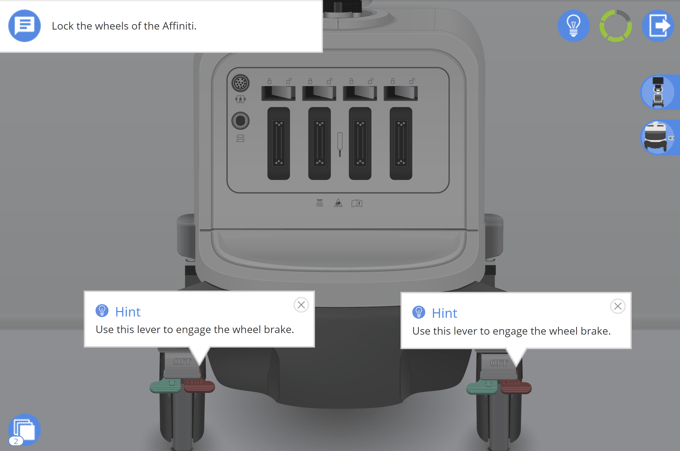
A passing criteria is determined for each assessment based on what needs to be assessed and the complexity and risk attached to a learning goal.
Passing an Intermediate assessment serves as a proof that the trainee acquired sufficient knowledge on a subject. During an Intermediate assessment, trainees still can request a Hint when they need support in correcting themselves, but only after making a mistake. This Hint system allows trainees to decide when they need support. Passing the Final Assessment without Hints guarantees that the trainee is competent in using the medical device.
By applying fading of guidance, we look forward that our training will offer support to those who need it while challenging trainees to perform the best they can.

The FDA specifies, “Each manufacturer shall establish and maintain procedures to ensure that the design requirements relating to a device are appropriate and ...

Medical device training in hospital settings is traditionally instructor-led, paper-based, and ultimately inefficient. Hospitals are increasingly adopting ...

Hospitals must prioritize medical device training — for patient safety, risk management, regulatory compliance, reducing cost and increasing operational ...