

Insight
Defining and addressing medical device user needs
The FDA specifies, “Each manufacturer shall establish and maintain procedures to ensure that the design requirements relating to a device are appropriate and ...
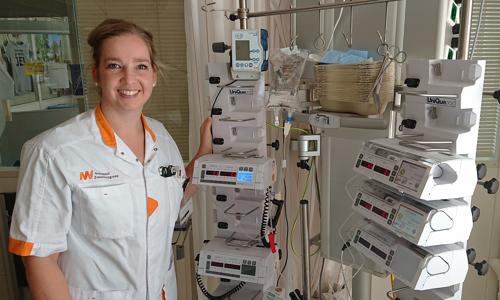
For the introduction of the new Arcomed infusion pumps at Noordwest Ziekenhuisgroep (hospital in the north west of the Netherlands) LeQuest has implemented two e-trainings. Due to the collaboration with Noordwest and distributor QRS Healthcare, we ensure that professionals from various departments are and will remain competent in the use of the infusion pumps. We spoke with various involved parties from Noordwest.
Roel Matulessy is team lead Medical Technology and explains why competent staff is of great importance to him: “The Dutch Covenant Medical technology isn’t only about the equipment, but its main focus is to guarantee safety. If a nurse is not qualified and competent in the use of the device, then it’s a risk to patient safety. The long-term arrangement with LeQuest, ensures that all nurses are trained in the same manner and with the same quality during the life span of the infusion pumps.”
Roy Koendering is training advisor at Noordwest Academie and explains the training process: “We have applied blended learning. The training process started with the LeQuest e-training. This ensured a high quality entry level with uniform basic knowledge. The hands-on training that followed was much shorter than we’re used to and allowed more in-depth topics.
The introduction of the previous infusion pumps still fully relied on key-user training. Matulessy: “Back then we were very dependent on the key-user(s). As a result, a big chunk of that knowledge was lost when a key-user left. Through the years what you’re actually left with is a manual and a few experienced users. Currently we’re still relying on key-users, but not in the train-the-trainer principle anymore. We use them in a way which really adds value: as substantive experts and as points of contact when problems arise.”
“In an ICU-environment, where there is an abundance of trainings, nurses can become ‘training fatigued’” Koendering continues. “That they could do the e-training at any moment whenever they had time for it, was a huge advantage. The high completion rates support this. In addition, we saved time since the hands-on training was shortened.”
ICU-nurses Sandra Entes and Laura Goedhart, who provided the hands-on training, endorse the advantages of the LeQuest e-training: “The e-training was really clear and in an understandable language. You could do it in your own time and also always go back or restart. The knowledge sticks well, now we feel that we’re 100% competent. It provides a piece of security at the bed. When an alarm goes off you know exactly what to do. That works extremely well. The transition from theory to practice was very nice. The simulations in the e-training are lifelike, you really have to perform all actions and press the buttons. Now I have the feeling that I know all relevant details and functionalities of the device. Our hands-on training also went very smoothly and there were barely any questions because the nurses already knew the pumps well due to the e-training.”
The competence of the nurses in the use of the device resulted in less user complaints at the Medical Technology department. Matulessy: “The reports we received, were mainly malfunctions of the device itself. The current amount of user complaints is considerably lower in comparison to previous replacements of the infusion pumps.”
Koendering also commends the excellent service of LeQuest: “We were very pleased with the support provided by the service desk. The administrators of our learning portal do not have knowledge of the training content, but can directly refer the questions to LeQuest. The service desk deals with the questions very adequately. Our feedback about the e-training was well received and implemented to improve the training even further”
In closing, two tips for hospitals that are engaged in the purchase of medical equipment. Matulessy: “Include education in your budget. This ensures that the e-training is available over the entire life span of the infusion pumps.” And Koendering adds: “There are two types of maintenance: technical maintenance and educational maintenance. At some organizations they hardly look at the latter; introduction of the device comes with a one-time training. My advice is to look at the long-term. A long-term agreement ensures adequate education during the entire life span of the device”

The FDA specifies, “Each manufacturer shall establish and maintain procedures to ensure that the design requirements relating to a device are appropriate and ...

Medical device training in hospital settings is traditionally instructor-led, paper-based, and ultimately inefficient. Hospitals are increasingly adopting ...

Hospitals must prioritize medical device training — for patient safety, risk management, regulatory compliance, reducing cost and increasing operational ...